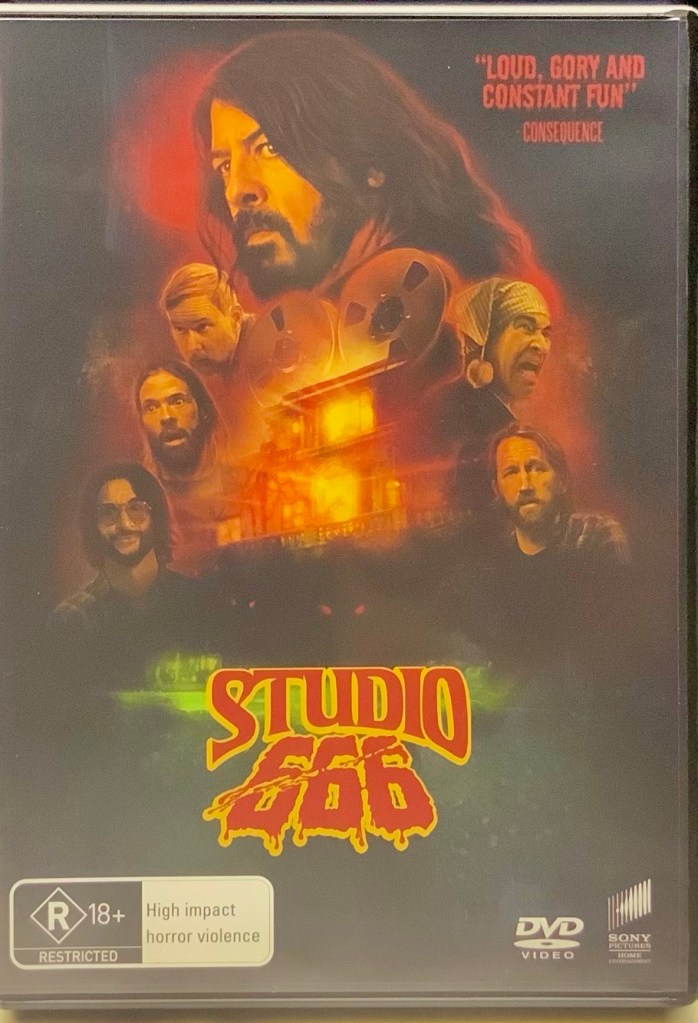
The cover to the Australian DVD release of Studio 666
Film: You know that when you get a movie starring a famous popular musical artist that your in for a treat, right? How good is Glitter, starring Mariah Carey… or Crossroads, with Britney Spears… or Spice World, with the Spice Girls…
Ok, I have to confess the Spice World movie is a guilty please, but I think you get the idea!
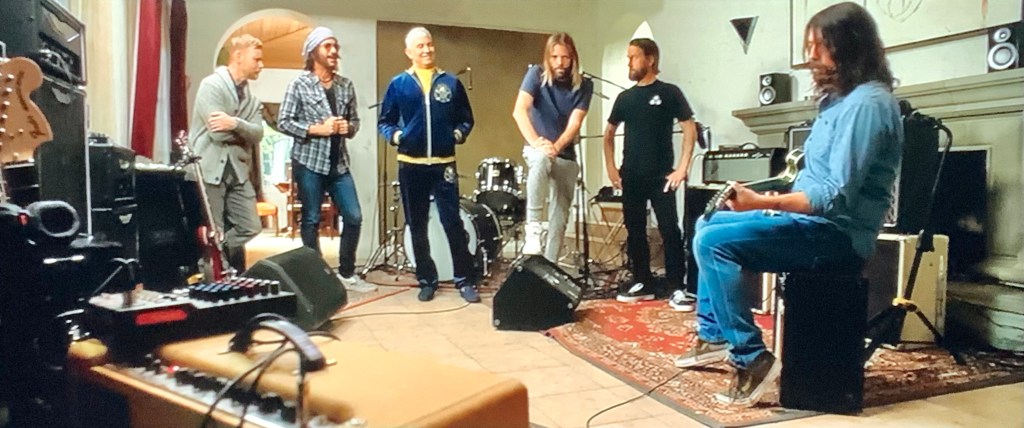
Dave (Dave Grohl) and his band, The Foo Fighters (played by… well The Foo Fighters) are trying to come up with something special and different for their tenth studio album. Their record company man, Jeremy Shill (Jeff Garlin) will do anything to get them to produce the new album so when they ask for a new studio environment, he gets his real estate agent, Barb (Leslie Grossman) to find them somewhere.
The Foo Fighters in all their glory!
What Barb finds them is a house in Encino that has a horrifying past, and very quickly, Dave starts seeing strange things and acting weird. The next door neighbour, Samantha (Whitney Cummings) tries to warn them of the house’s history, but has she come too late… well, of course she has!
This movie was written by Grohl and the a screenplay was adapted from it by the 2019 Pet Semetery remake writer, Jeff Buhler and Der Vulkan’s Rebecca Hughes. It’s director, BJ O’Donnell is best known for directing music clips for Slayer and other heavy metal bands, but was also responsible for Hatchet 3.
It’s certainly The Foo Fighters Show, and not only are they good at playing themselves, their comedy timing is impeccable and hilarious. It’s certainly a love letter to heavy metal, with a lot of new music played, and some amusing covers of old ones, including a hilarious scene where Grohl is abused by a dream version of Lionel Ritchie, PLAYED by Ritchie, for trying to steal his love ballad ‘Hello’!
Don’t think the guest stars stop there. In addition to Ritchie and a role played by comedian Cummings mentioned earlier, we also see a roadie named Krug (no doubt a reference to Last House on the Left) played by Kerry King, and the music producer, Rip Haight is played by director and composer extraordinaire John Carpenter, the joke being his characters name is an alias he has used occasionally when playing roles in his own films.
A tribute to The Burning
It’s a pretty solid story, both suitably gory and really funny at times. There is a lot of references to horror movies too, like Evil Dead, The Exorcist, The Burning and probably many more that I missed.
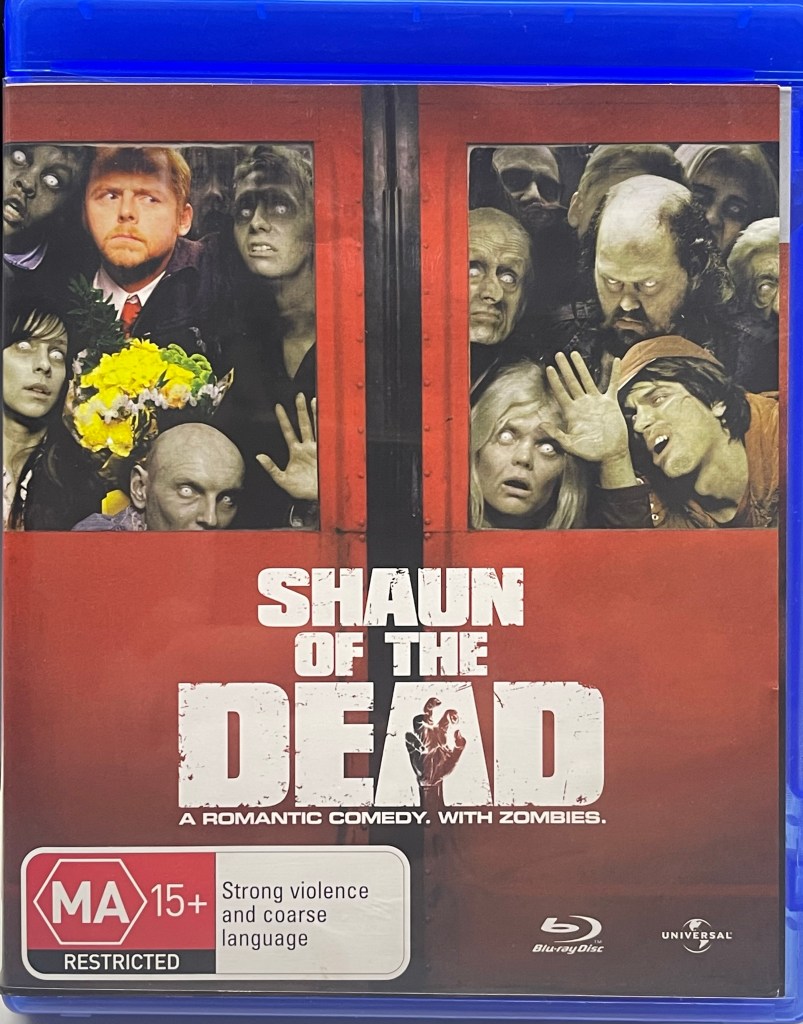
Studio 666 is an amazingly fun movie that would be a great double feature with something like Shaun of the Dead. This could have been an ego fuelled, cluster bomb of tripe but the entire production is a fun watch. The only two things that disappointed me were a lack of extras, and we only got a DVD release here in Australia.
Score: ****
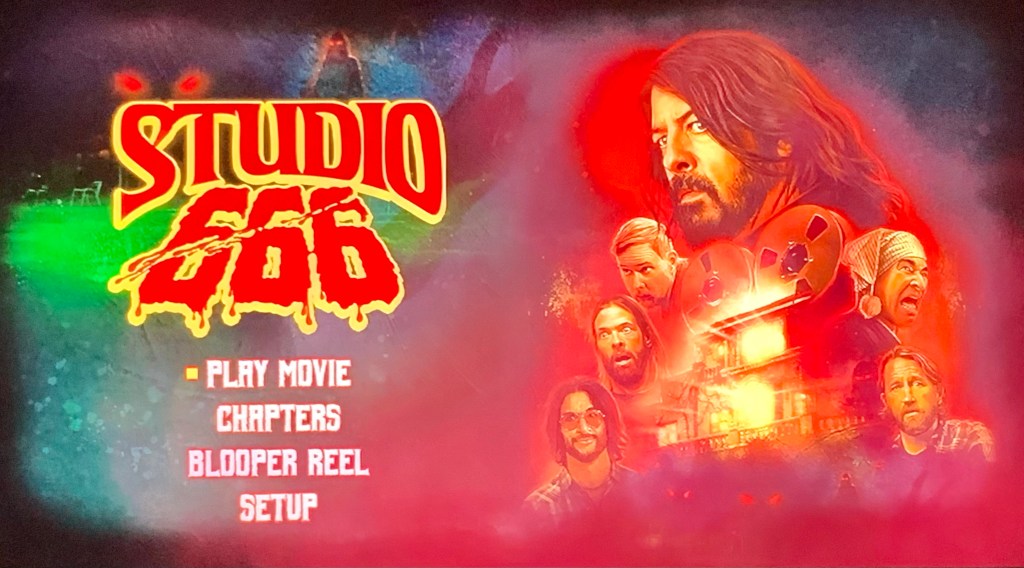
The menu screen to the Australian DVD
Extras: There’s only one extra which is a gag reel, but for the first time in along time, it did actually get a chortle out of me here and there.
Score: **
WISIA: Hell, yeah! A gory horror comedy that’s ACTUALLY funny.
I’ve heard of ‘splitting the whisker’ but I don’t think this is right!
This review was done with the Australian DVD release.
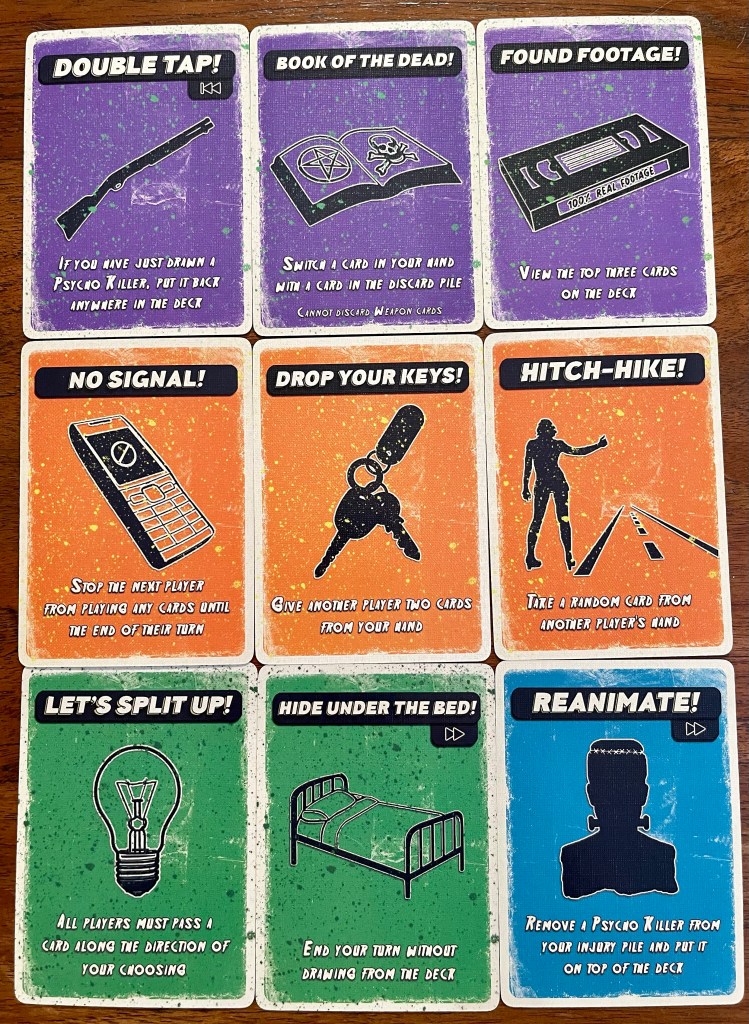
The main game of Psycho Killer and it’s expansions
Several weeks ago, I did a review for a fun card game called “Psycho Killer’ from Escape Tabletop Games. The kind people from VR Distribution in Australia saw this review and kindly offered me a copy of each of the expansions to review.
If you wish to read that review, you can find it here: Psycho Killer Card Game – go back and read that first before embarking in this review.
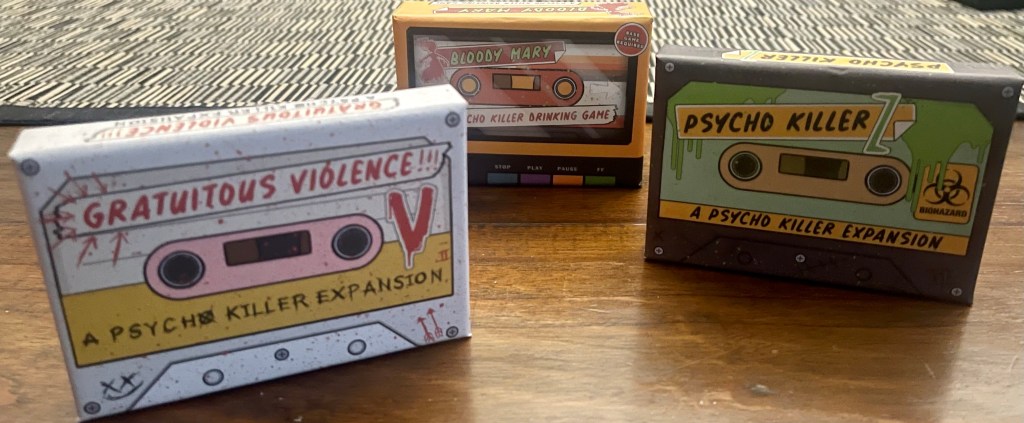
The three expansions
In that original review, I do criticise the game for being packed in a far-too-big box for how small the game is, and when I saw how small these expansions are I assumed they would fit in the box with the original cards, which they do, but only if you remove the inserts that hold the original cards in place, or you can take these cards out and throw them in the box which would be a shame, because the audio cassette/ Walkman boxes are pretty cool.
Just on that: the boxes for these expansions ARE cool, but make no sense thematically. The original game, set around slasher films of the 80s come in a video tape, which is bang on for theme, but these seem to be more about the box art theme of the original rather than the game theme. Sure they all look cool together, but I just don’t get it.
The three expansions are called Gratuitous Violence, Z and Bloody Mary.
Psycho Killer: Gratuitous Violence
Gratuitous Violence is our first expansion, and it adds a much more combative experience. There are 15 cards in this little tiny box, all marked with a ‘V’ so if you want to play the game WITHOUT these cards, they are easily removed.
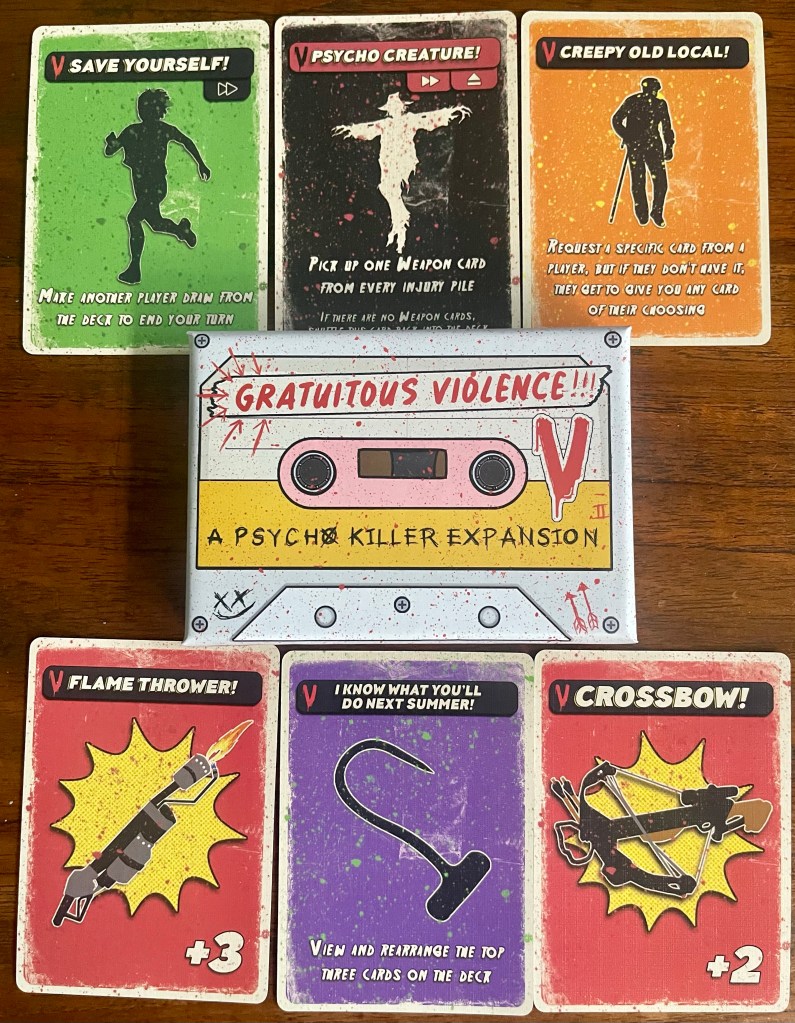
First, it adds a Psycho Creature to the pile, if you draw this guy, you don’t just drop all your weapons, you also take one from each other player… yikes! Save Yourself allows you to force another player to draw your last card instead of you. Creepy Local let’s you try to steal a particular card from another players hand. I Know What You’ll Do Next Summer let’s you look at rearrange the top three cards so you can pick who gets what for the next three hands, and finally, three ranged weapons (Flame Thrower, Crossbow and Hunting Rifle (not pictured)) which have the unique ability of the player holding them being able to put them on another players weapon pile to increase THEIR score.
An example of the cards from Gratuitous Violence
As you can see, these cards add a really nasty, attack-other-players element to the game, and the word “BAST-AAAAAAAAARD” will be exclaimed often. Also, the addition of the extra cards means that the player count can be increased to 7, so you can make even more people angry!
Score: ****
Psycho Killer: Z
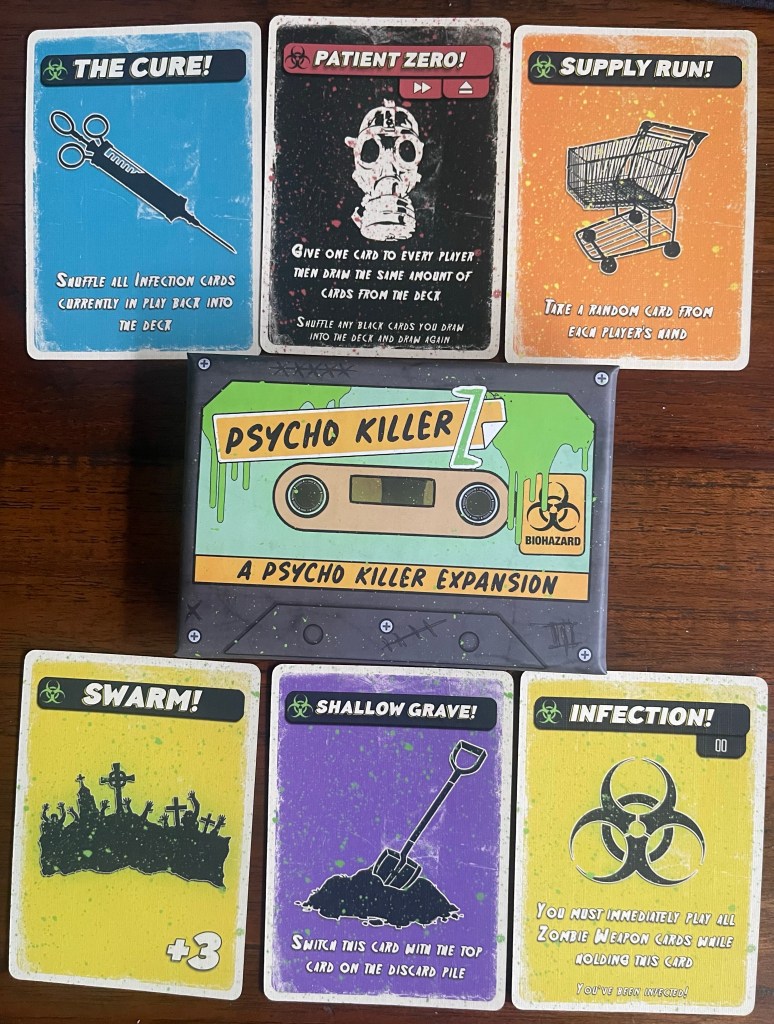
Z is the next expansion, and adds a zombie apocalypse to the threat of a Psycho Killer. Again, this card adds enough cards to the deck so you can increase the player count to 7, but whereas Gratuitous Violence was all about attaching other players, this is all about you as an individual.
This expansion is all about getting infected by a zombie virus, and then trying to get rid of it to another player. The weapon cards in this expansion are all zombie attacks (Bite, Scratch and Swarm) but they don’t get played when a Psycho Killer attacks, but instead they get played when you draw an Infected card, and you will keep playing those cards as long as you are infected.
Some of the cards from Z
You can get rid of the card though, with either a The Cure card, in which you shuffle it back into the deck (keeping your wounds), a Supply Run card, were the player takes one card from every players hand (maybe they’ll take that infected card) and the Patient Zero Psycho Killer card, where you distribute your cards to the other players. There is also a Shallow Grave card, which can be swapped with the top card on the discard pile; got an Infected card? Swap it with a played The Cure, if you are lucky!
This expansion is hilariously self-destructive, but the zombie injury cards are affected by the Band Aids and Stitches cards from the main game, also cards like Let’s Split, Drop Your Keys and Disarm can also be a way to rid yourself of the Infected card.
Score: ****
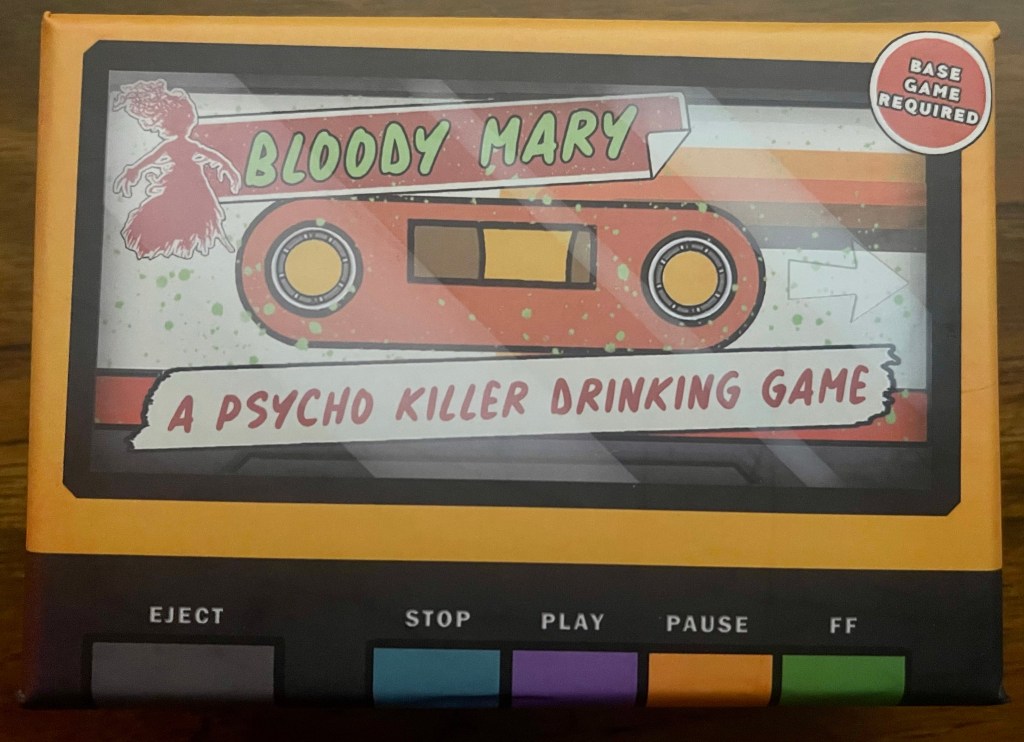
The box for Psycho Killer: Bloody Mary
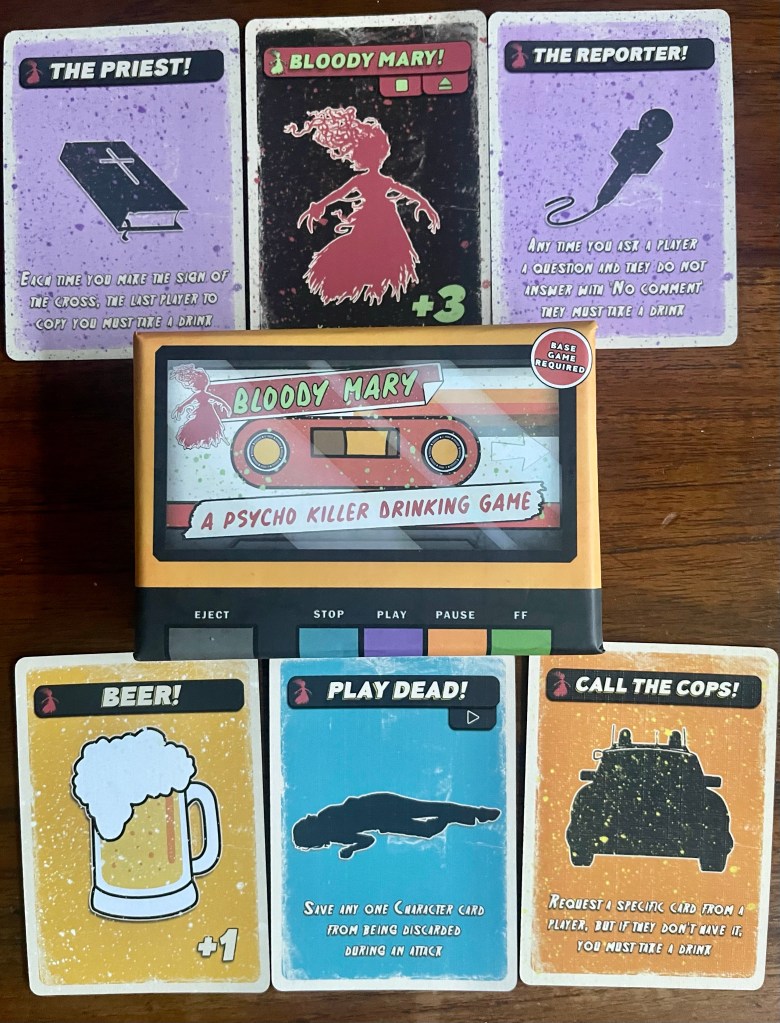
Bloody Mary is the final expansion, and it turns Psycho Killer into a drinking game! The first thing one must do to play this game as a drinking game, is to remove all the Psycho Killers and Weapons cards from the base game, and replace them with the Bloody Mary cards, and the Drink cards. The scoring is still the same, except when someone gets a Bloody Mary card, everyone has to take as many sips of their drink as the points on the card say. For example, if you got a Bloody Mary (+3 points) and placed a Beer card with it (+1), you would take 4 sips of your drink.
This game also adds ‘Character Cards’ to the mix as well. While you have a character card in your hand, you must take on the persona of that card. For example, if you have The Bartender in your hand, it’s your job to keeps everyone’s drinks filled, The Final Girl stops you from taking a drink, and The Jock allows you to pick a member of your frat, and they have to drink whenever you drink. These character cards make for an interesting experiment in the game, and even cards like Play Dead allows you to keep a character card should the opportunity come up where a character is to be removed, which is whenever a Bloody Mary is played.
A sample of cards from Bloody Mary
There’s also other drink-oriented cards like Pass Out Under the Bed, where instead of drawing a card to end your turn, you take a drink, and Splatter, where everyone must keep drinking their drink until they finish theirs, or you finish yours!
I’d like to point out at this point of the review, that the To Watch Pile encourages everyone to drink responsibly, look out for your buddies and please, don’t drink and drive.
This box also has a bunch of blank cards do you can create your own Psycho Killers: maybe your deck needs a Cropsy (drink a flaming sambuca), or a Madman Mars (you have to spend 5 minutes awkwardly in a spa with another person while terrible music plays), or even a Norman Bates (player wears a wig and impersonates their mother until the next Psycho Killer is drawn).
I have to make the points on this one a bit lower than the others for two reasons. One, the re-jiggery-pokery of the deck on setup is never a fun way to start a game, though the makers of the game have labelled all the cards with a little Bloody Mary so they are easily removed. The other issue is that it narrows the game to drinkers only, so under-18s are immediately left out as are non-drinkers. I think games are better when they appeal to a wider audience, and this narrows it. Don’t get me wrong, the actual mechanics of the drinking in this expansion are fun, but a non-drinker in your board game club isn’t going to get anything out of it. Also, it’s a shame the character cards weren’t in other expansions with non-alcohol related things for them to do, like maybe a ‘Lovers’ card who divide damage equally or something like that.
Score: **
These expansions all have a recommended retail of about $19.95, and I think the Gratuitous Violence and Z boxes are certainly worth it, even though the contents of the box don’t seem to be much. They do add fun extra elements of gameplay with a small amount of components. The Bloody Mary expansion I probably wouldn’t worry too much about, but I do like that you can make your own Psycho Killers! People whose board game nights turn into orgies of liquor might enjoy it.
I’d just like to offer a thank you to the people at VR Distribution for allowing me an opportunity to review their product.
In 2002, in the wake of the Star Wars prequels, the merchandising machine for George Lucas’ franchise went into overdrive, making everything from pyjamas to action figures, and in this case board games.
Milton Bradley/ Hasbro came up with a game called Star Wars: Epic Duels was a card based miniature game designed by Cthulhu: Death May Die’s Rob Daviau and Craig Van Ness, who made the iconic and much sought after Star Wars: The Queen’s Gambit board game… seriously, if you have one, I want it!
Unfortunately, Epic Duels disappeared, but Restoration Games unearthed it, dusted it off, removed the Star Wars skin on it and came up with an updated version, now called Unmatched: Battle of Legends Volume 1, a card based miniature game that had two players pitch characters like King Arthur, Alice (from Wonderland), Sinbad the Sailor and Medusa in..ahem… epic duels against each other.
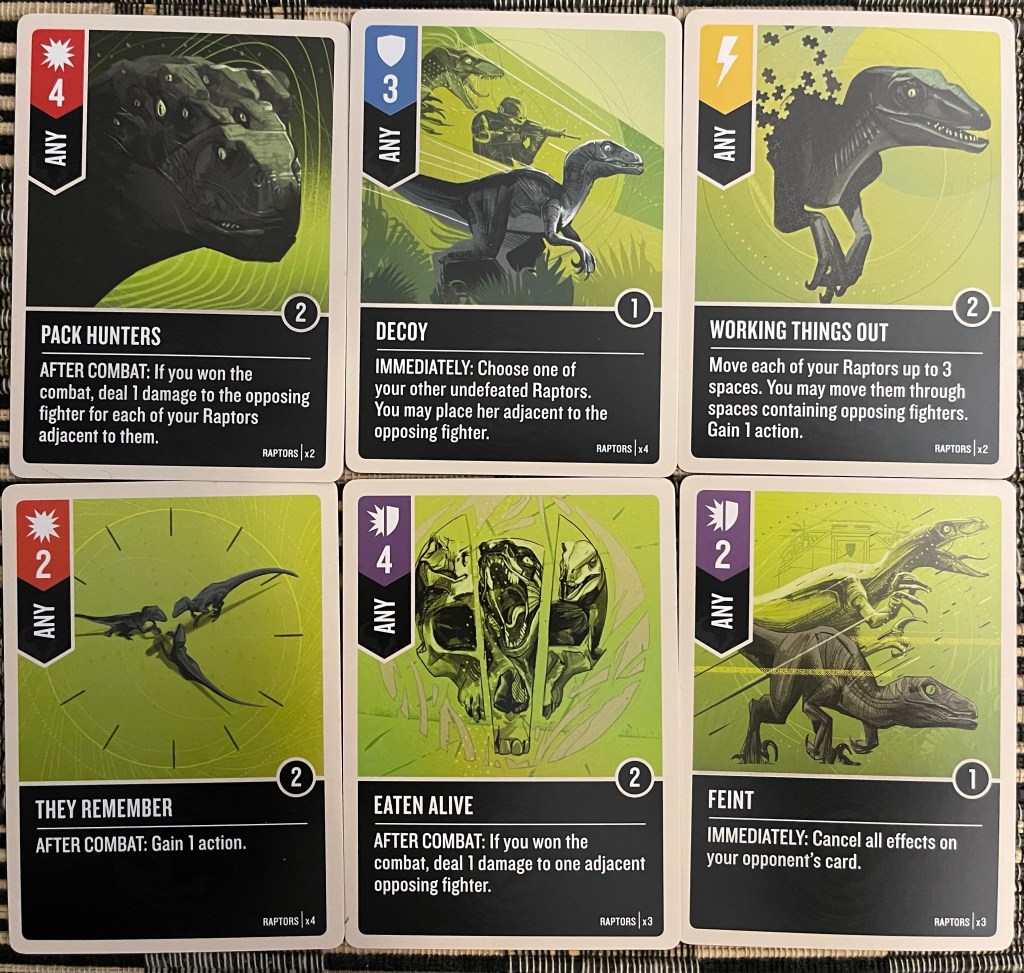
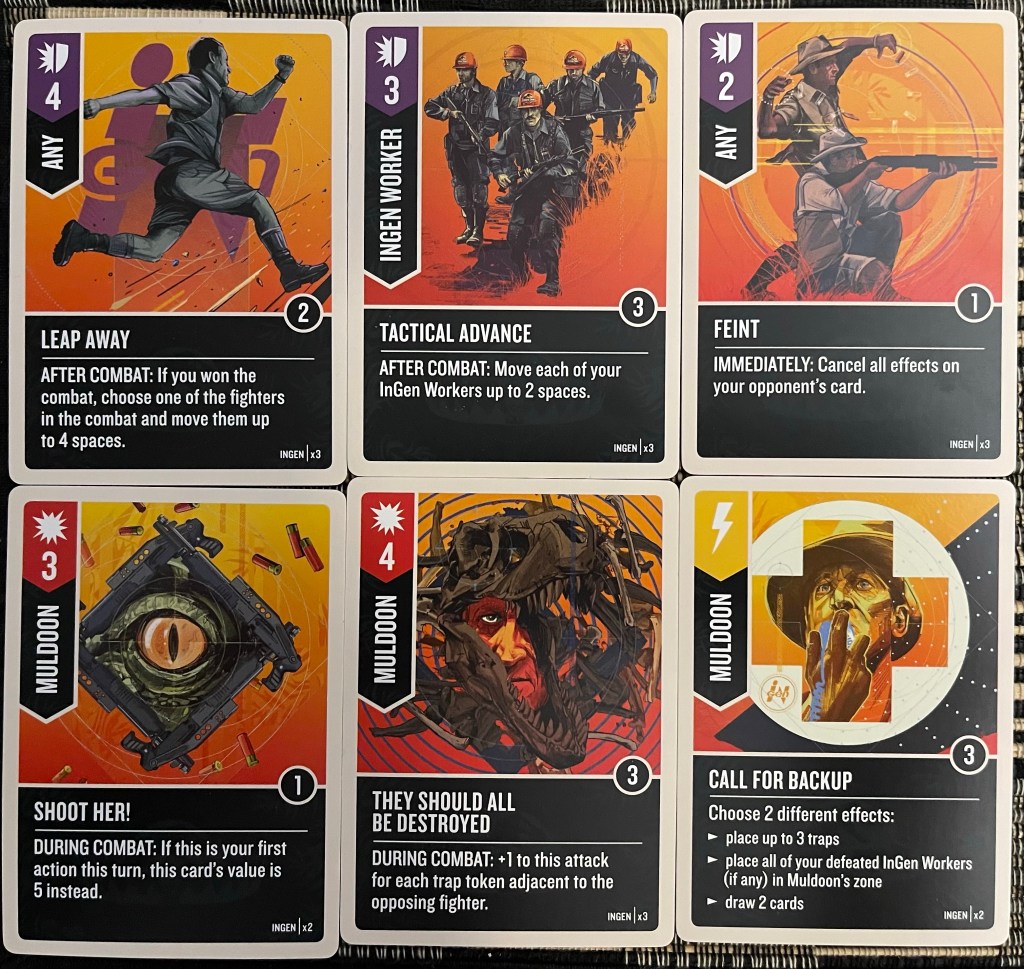
Velociraptor card artMuldoon card art
As this was an epically fun game, that also had beautiful card art from the people at Mondo, best known for amazing posters and soundtrack art, and minis from Punga Miniatures, of course expansions started to emerge, and very quickly we had characters from Buffy the Vampire Slayer, Marvel comics, Bruce Lee (!!!), other older literary and mythological characters (like Dracula, Sherlock Holmes, the Invisible Man) and in this case, Jurassic Park.
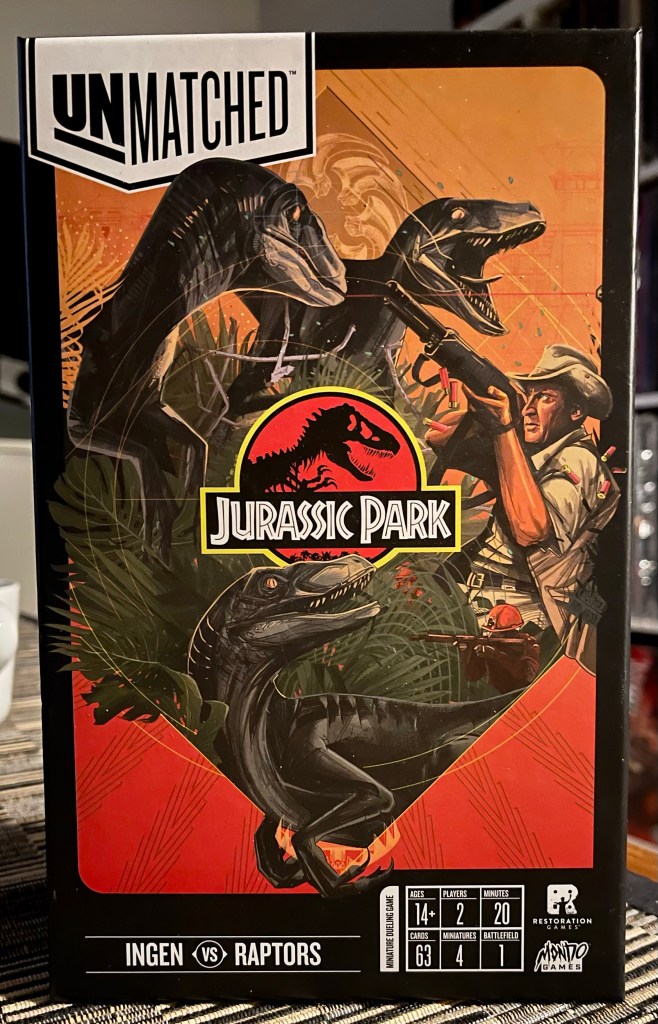
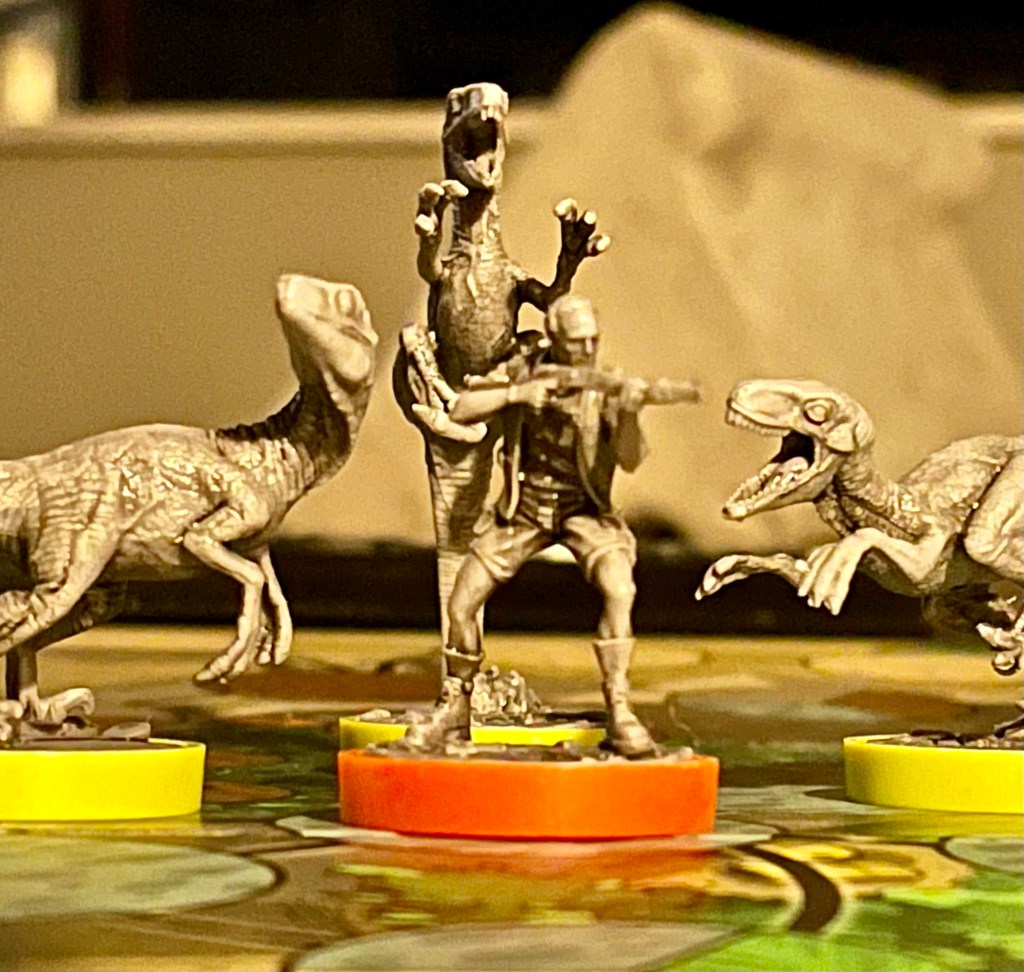
Unmatched Jurassic Park is the first of three JP based expansions, one other having a T-Rex vs Ellie Sattler and Ian Malcolm and an Alan Grant one announced, and has us pitch the big game hunter Muldoon up against three velociraptors. I call them ‘expansions’ but technically, every game of Unmatched that has more than one character in it, is a game in its own right, and can be played without any of the other editions.
The miniatures can be paintedor left unpainted as I have done
This game is very easy to play… you don’t need to be very clever girls (geddit?)… and is started with two players deciding whether they want to be Muldoon or the dinosaurs. Once decided, the players place their starting minis, and in the case of Muldoon, their Ingen employee chits, on the board, collect their deck of thirty cards, their player cards and their life counters, they then draw seven cards each and get ready to rumble. This seven cards is their hand limit for the game, so if at the end of a turn they find themselves with more, they have to discard down to that limit.
On each turn, the players have to draw one card, and then have a choice of actions:
– move: each mini can move up to its limit shown on the player card, unless they have a card in their hand that boosts their move limit.
– scheme: you may play a special effect card onto one of your chosen minis
– attack: using your cards, the player may attack another player if they are within range. To perform combat, the attacking player takes a combat card from their hand and place it face down in from of them, and the defender does so with a defence card. Both players reveal their cards and the defence score is removed from the attack score, and the remaining points are the damage taken. Some cards do have additional effects, so they also take place, potentially diffusing or increasing an attack.
A game set up and ready to play
This moving, scheming and attacking continues until the character mini is reduced to zero health, in the velociraptors case, all three being reduced to zero. The three versus one might seem unfair, but Muldoon has ranged attacks, Ingen employees to distract the dinosaurs and traps to corral them, or catch them.
One thing I didn’t mention with the other sets of Unmatched is they are completely mixable and matchable. You want Buffy the Vampire Slayer to fight Muldoon? Do it! Dracula versus the velociraptors? Go for it! Every set can be played against each other, so buying many sets is a must, especially when all those Jurassic Park ones are finally released!
At my place, we even used a round robin generator to create the matches for us – let me tell you, I was pretty angry when Bruce Lee beat my velociraptors, though I expect that he probably could.
The box interior is designed for easy pack up!
Even though this review is for the first Jurassic Park version Unmatched, it really is a review for all of them. Throughout the series, of course some characters are better than others, but it’s not just the specs for the character, it’s also the way the player plays. I have been beaten with characters that I didn’t win with, so play style comes into it a lot.
I love this game. The art is fantastic, the minis are beautifully designed and executed and the gameplay is simple enough for it to be accessible to gamers of any level to play it, but once you’re in, it becomes a thinky exercise that almost chess-like in its execution. Weirdly, for a game that spreads its mechanics across various themes and franchises, each character is true in its play style to its theme; a difficult exercise to execute well. Heaps of fun, buy it.
Film: In this humble reviewer’s opinion, the best horror movies are the one where people like you and me are put into extraordinary situations. Night of the Living Dead stands out as an example of this; a group of faceless no-ones, drawn together to fight a common evil. Luckily for those folks they had the convenience of finding a domicile that had a firearm in it, but look around your own house, what do you have to fight back the hordes of the undead…a tennis racket? A cricket bat? A baseball bat? I imagine that the amount of houses that have NO guns would outweigh those that do, so to react against this sort of thing we would use whatever is handy…this is the world of Shaun of the Dead.
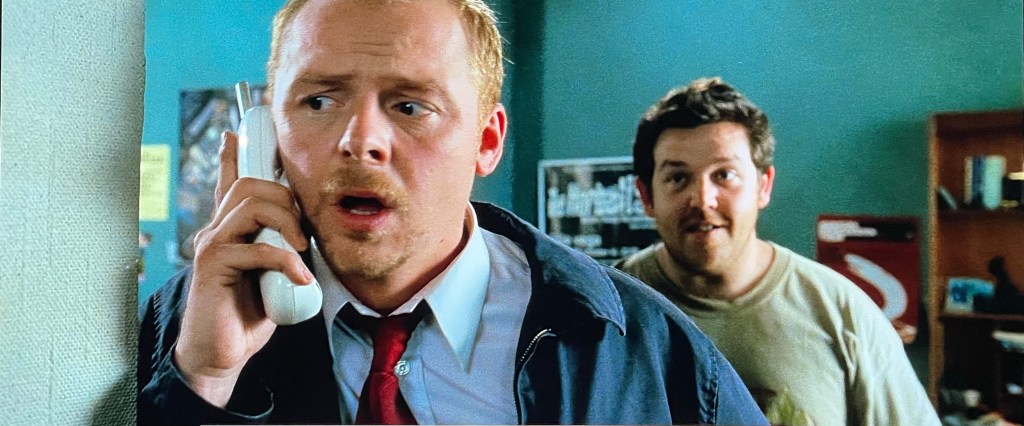
Simon Pegg as Shaun and Nick Frost as Ed
Shaun (Simon Pegg) is just like you or I, with all the same problems. His job sucks, his girlfriend, Liz (Kate Ashfield) has left him due to his flagrant disregard for their relationship, and his obsession with the local pub ‘The Winchester’, and he forgets to call his Mum (Penelope Wilton) regularly, which bring about much agro from his step-father (Bill Nighy) …general details of life that can lead a man to drink until he cannot feel his legs anymore, but Shaun’s problems are getting worse. The dead are rising, with a ravenous lust for human flesh. Shaun has to make a plan so that he can keep himself and his loved ones safe. Along with his best pal, Ed (Nick Frost), he comes up with a plan that will keep Liz, her disapproving flat mates Dianne (Lucy Davis) and David (Dylan Moran), and his mother and step father safe and well until the whole problem blows over…that is, as long as nothing untoward happens…
The walk to the pub is more difficult than normal.
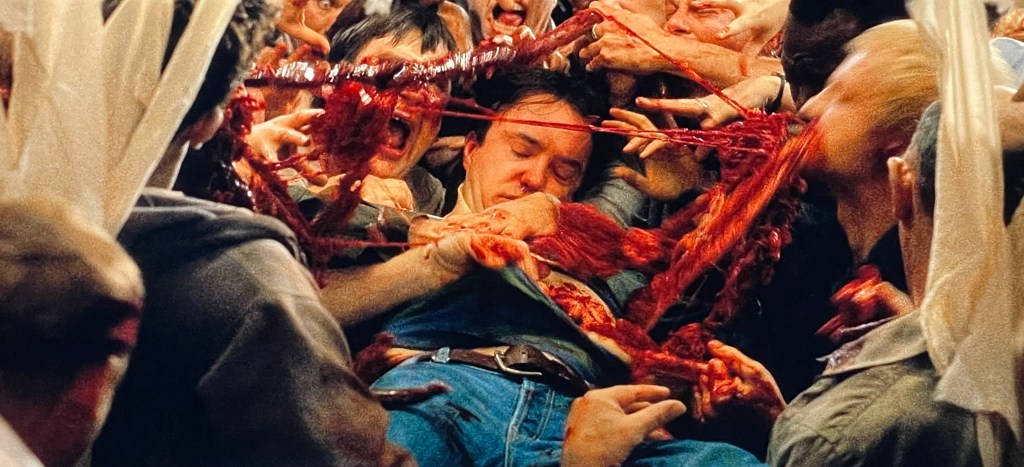
Shaun of the Dead runs the gamut of gruesome gore and clever comedy…so much so you may find your head spinning. There are so many references to other zombie films that you probably won’t pick up on all of them the first time you watch it, like the Italian restaurant named Fulci’s, the electronics store called Foree’s, and the assistant manager named Ash. Seeing as how the creators and many of the other cast are from the Pegg/ Wright creation, Spaced, there are many subtle tips of the hat to that show as well, not to mention a selection of English comedy and music favourites (look out for Little Britain’s Matt Lucas, The Hobbit’s Martin Freeman, League of Gentlemen’s Mark Gatiss and Reece Shearsmith and Coldplay’s Chris Martin and Jonny Buckland to name a few). As for the zombies themselves, well, there are some really freakish ideas, like a wheelchair bound zombie…and I shall never look at twins the same way again. Also interesting is the way that Pegg and Wright have compared our mortal existences to those of the hordes of zombies. Are we really any different?
Score: *****
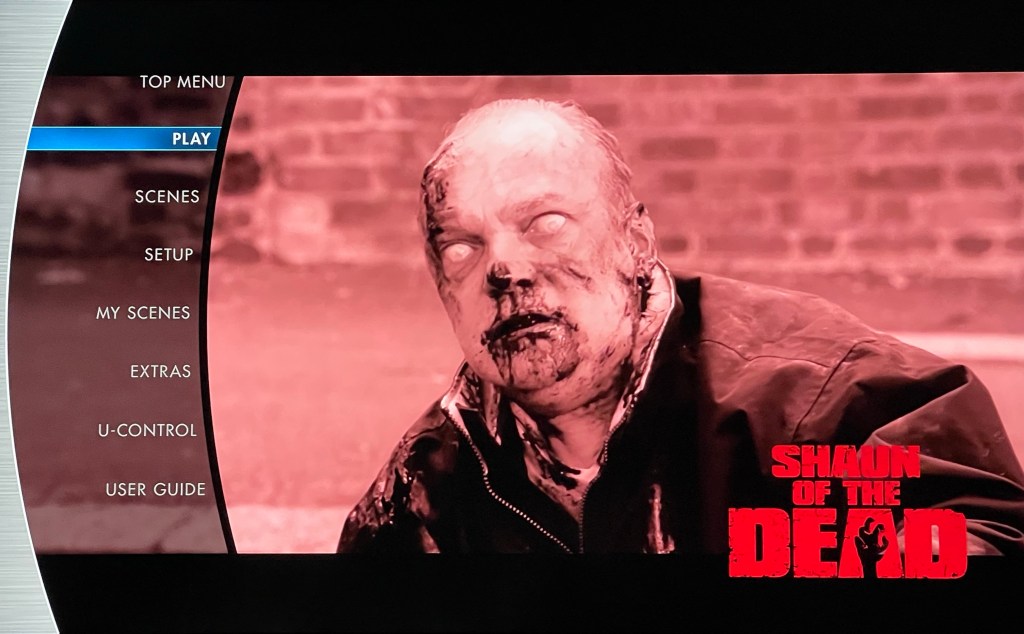
The menu screen to the Australian Bluray release
Extras: The commentary is by Simon Pegg and Edgar Wright. Half trivia track, half informative and half stand up comedy (hang on, is that 3 halves? Oh well) this track is really one of the best commentaries I have ever heard. It is fun and entertaining, and a great way to get help to spot all the ‘horror asides’.
The special features are divided into a few sections:
Missing Bits contains:
Extended Bits is a selection of scenes from the movie that were trimmed for various reasons. This extra can be played with or without the commentary by Simon Pegg and Edgar Wright.
Outtakes, surprisingly, are a selection of amusing outtakes. One warning though, within these outtakes contain the worst Beatles impressions you will ever hear.
The Man Who Would Be Shaun shows Nick Frost and Simon Pegg fooling around with different accents in a particular scene.
Funky Pete which shows the ‘clean’ version of a scene for the airplane version where all the ‘F’ words are changed to the word ‘funk’…do you funking well understand what I funking well mean…you mother funker?
Plot Holes contains 3 sections: What happened to Shaun when he ran off, What happened to Dianne When She Left the Winchester and How Did Ed get from the Cellar to the Shed. These sections are done as comic strips, with the tale told by the respective characters, and fill in the plot holes quite suitably and amusingly.
Raw Meat contains:
Peg’s, Davis’ and Cornish’s Video Diaries is a selection of cute behind the scenes stuff done by, well, the people whose names each short is named after. It seems to be more of a look at how mundane filmmaking is. Cornish’s harrowing trip to his day as a zombie extra is both funny and frustration.
Casting Tapes is some footage of the casting process.
Edgar and Simon’s Flip Chart which is a run through of the film by the writer done in September 2001 using a flip book (often used by teachers or in business meetings), and is a quite amusing run through of the movie, before it was even filmed.
SFX Comparison is just that. A few scenes from the movie with the special effects removed, so you can see what had to be done to get some of the effects.
Make Up Tests shows close up views of some of the zombies from the movie, with and without the ‘eye’ effects put in, and a few ‘zombie walk’ tests.
EPK Featurette discusses the origins of the movie and what the lead actors and the director thought about their roles within the movie, and also whether they are making a horror, or a comedy, or something new altogether. It is a bit of a fluff piece, but kept interesting by the personalities of the cast and crew.
TV bits contains:
Is a bunch of ‘in the world of Shaun of the Dead’ TV spots, featuring an interview with Chris Martin from Coldplay about their charity ‘Zombaid’, a game show for zombies (featuring the ‘Gonk’ piece of music from Dawn of the Dead), some bits with Tv\V presenter Trisha and a News reader recalling ‘Z Day’; the day the dead came back alive.
Zombie Gallery contains:
Photo Gallery is a series of behind the scenes photos taken of the cast and crew at rehearsals.
2000AD Strip a comic stripped based on part of the film, taken from the English sci fi comic 2000AD.
Poster Designs, which is a series of poster ideas for the film.
Trails of the Dead contains various trailers for Shaun of the Dead, including the teaser trailer from Fright Fest 2003.
Finally, in this exhaustive and thorough pile of extras, is a storyboard feature that allows you to, during the film, hit enter on your remote whenever a pair of zombie eyes pop up, to see the storyboard for that section.
Score: *****
WISIA: Yes. It’s easily the best part of the Cornetto Trilogy and is just so much fun.
It’s a zombie movie: not everyone survives!
This review was done with the Australian Bluray release.
David Byrne from Talking Heads once said;’ Psycho Killer, qu’est-ce que c’est, fafafafa fafafafafa better, run, run, run, run run away.’ It doesn’t mean anything in regards to this card game review, but he did say it… on SEVERAL occasions!!
There’s nothing I love more than a tidy little card game that is easy to learn, and the teach can be taught in minutes. The reason I like this is that it’s nice for my wife to have a card game or two in her hand bag, and when at the pub, it can be whipped out for a quick few rounds.
Unfortunately Psycho Killer from Escape Tabletop Games doesn’t come in one of those little boxes, but to their credit, they have put the base game into a box that will eventually fit the expansions if you choose to buy them, and I guess if you want to, you can just throw the original deck into a smaller box for travel. Also, and I have to point this out before I go any further, the box is in an awesome replica of a VHS tape, which is very thematic for the game. It just proves that even though I think I’m nostalgia proof, I definitely am not!
(NB: the expansions to date are a zombie expansion, another called Gratuitous Violence and a drinking game addition called ‘Bloody Mary’.)
If one of these comes out of the deck, you’re all in trouble.
The game does fit that previous criteria though, as the short instructions take minutes to read, and the play explanation takes even less, so if you do decide to whip it out and introduce it to people who haven’t played it before, you’ll be up to your guts in no time. This game is a clear example of it not being the size that counts, but what you do with it instead.
In Psycho Killer, you play potential and eventual victims of a slasher who wants you dead. The winner is determined by who has the less injuries at the end of the game, which is determined by when the fifth psycho killer card is drawn from the draw pile.
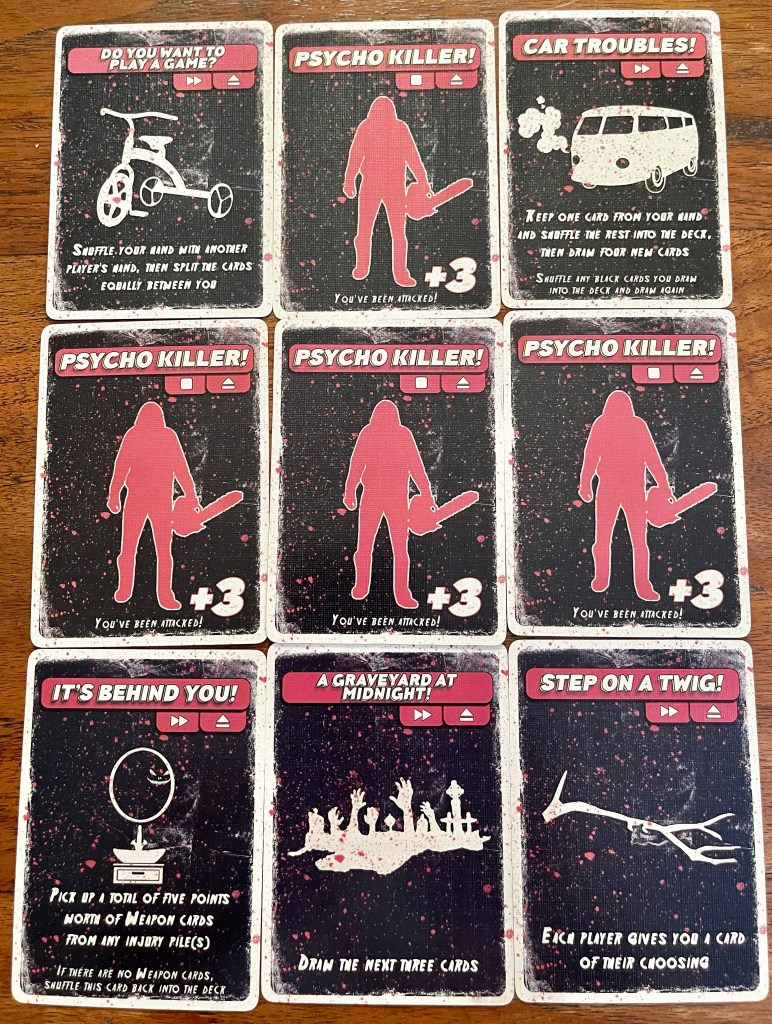
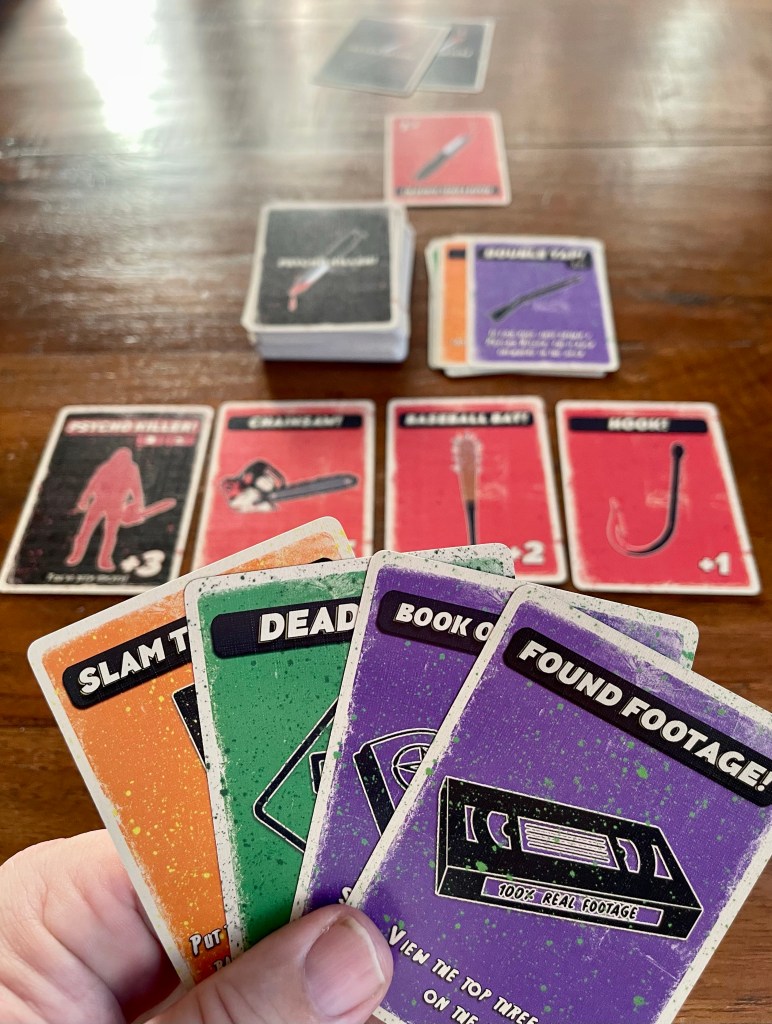
The regular cards
Play is simple. To set up, take the cards with black backgrounds (these are the psycho killer and bad event cards) out of the deck and deal 7 cards to each player. Shuffle those black cards back into the deck and place that deck as a draw pile in the middle of the table.
Each turn, players play as many cards as they can from their hand, and finish their turn by drawing a card from the top of the deck to replenish their hand. If the card is a psycho killer card, they, and everyone else at the table have to play all their Injury cards, which determines how many points they have, and after the 5th psycho killer is drawn, the person with the lowest amount of injuries, wins!
Simple right? The curliness of the game comes from the fact that the other cards you play can see you moving your injuries to other players, checking the cards in the deck to see if you can avoid them, reversing the state of play and other such devious things that help you avoid injury. There is also a catch up mechanism too: if you have more than 10 injury points during the game, you are ‘left for dead’ and it gives you an advantage of being able to hold some of the black cards (not the psycho killer) in your hand until it’s strategically better for you to play.
I really like the theme of the game, and the fact that the design of it all fits well in with the VHS generation, and there is plenty of horror in-jokes or Easter eggs or whatever they are called these days for the big horror fan, and even the minor one. The good thing is that the theme doesn’t disturb the gameplay so if you aren’t a horror or movie fan, like my wife, it doesn’t get in the way of a fun game. I guess this also means the theme isn’t important, but I admit I did purchase this game because of it.
A game of Psycho Killer in progress
If I am to criticise this game for one thing, it’s the ‘when to play’ code on the cards. Thematically, using the emblems for ‘fast forward’, ‘play’, ‘eject’ etc to describe when each card has to be played is smart, but it’s not immediately accessible, and those casuals who aren’t big movie fans will ask on several occasions what it means, so be prepared for those questions!
All in all, Psycho Killer is a quick fun family game with a very non-family theme. Game length is random as you never know when those psycho killer cards are going to pop up, but the cards make it tactically fun as you cross and double cross your friends and family, allowing them to get more injuries than what you have, aiming towards that lower score at the end.
Of ‘classic’ genre literature, it’s probably H. P. Lovecraft and Sir Arthur Conan Doyle are the most represented in board games. For Doyle, it’s the puzzle aspect of Sherlock Holme’s stories that make for a good gaming cornerstone. As for Lovecraft, unfolding mysteries filled with bizarre aliens and maddening monsters make for a lot of fun too.
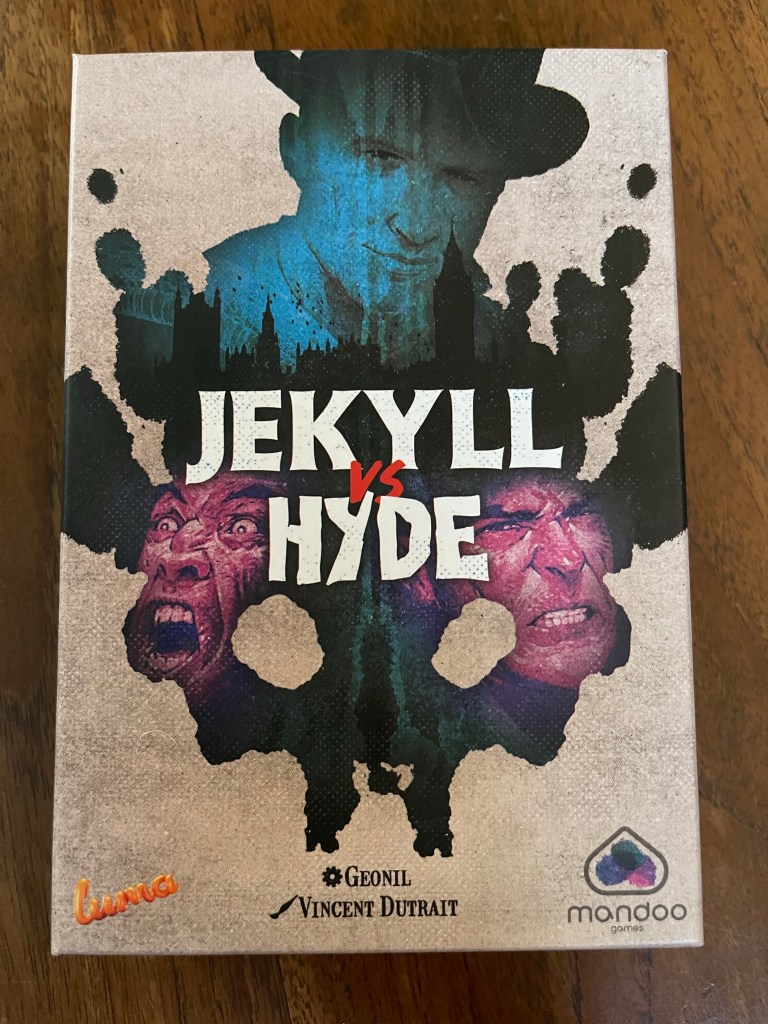
Sure, there and games revolving around Mary Shelly’s The Modern Prometheus (better known as Frankenstein) and Bram Stoker’s Dracula, but this little pocket-sized gem, Jekyll Vs Hyde is a card game based upon the book The Strange Case of Dr. Jekyll and Mr. Hyde, by Robert Louis Stevenson.
This game is a tactical, trick-taking game and is about the internal turmoil that Dr. Jekyll constantly goes through every day, and how he has to maintain an even balance to retain control of his body, whereas Mr. Hyde just wants chaos.
A game set-up and ready to play
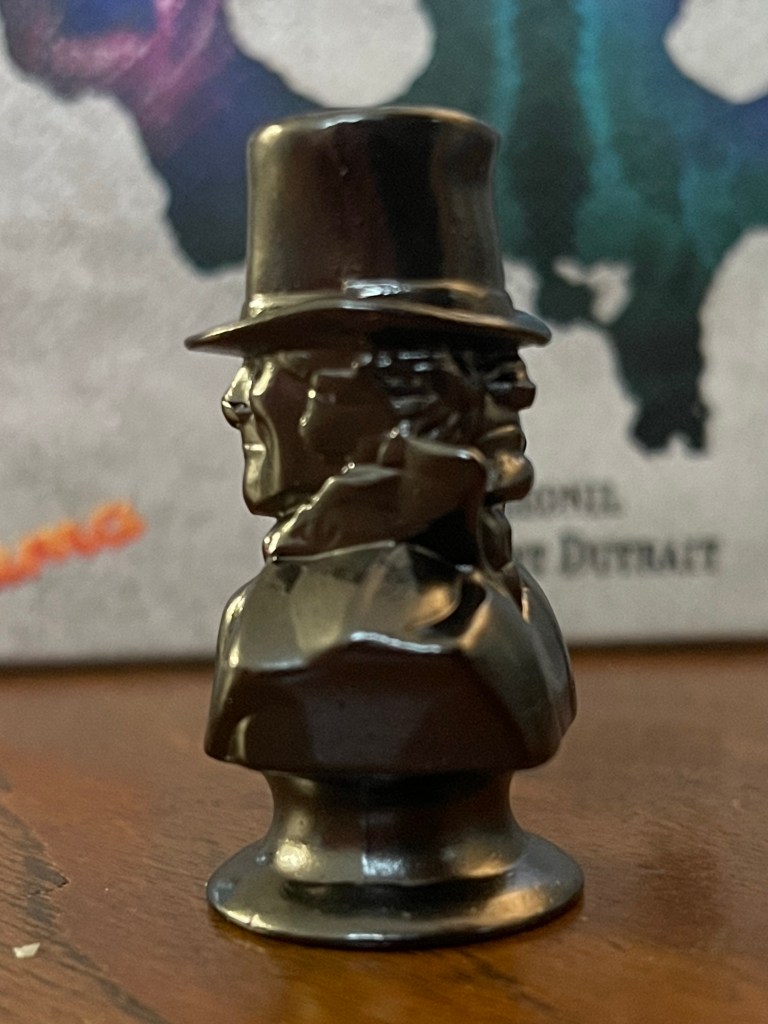
This game is played with a simple game board that represent the distance between insanity and sanity for Jekyll and Hyde, with a single miniature representing both of him, that starts on one side of the board, and through point scoring slowly moves across the board. Hyde’s mission is to get the token all the way to madness whereas Jekyll’s is to maintain balance. The game is played across three rounds.
The game starts with the Hyde player issuing ten cards to each player, and returning the other cards to the box. The cards come in three suites, greed (green), wrath (red) and pride (purple) and on each turn of the first round, the Jekyll player goes first, putting down one card, and then the Hyde player playing one.
The first colour that is put down sees a token put onto the board as the ‘weakest’ colour, and as other cards are played, each following colour becomes stronger.
Basically, the winner of each round is determined as such: if the Hyde player puts down the same colour, the highest of the two cards wins. If the Hyde player puts down a stronger colour, as determined above, the stronger colour wins. If someone puts down a potion card, the colour the other player put down activates the special abilities of the ‘strength’ tokens, which could be swapping hands, resetting the strength cards or taking one winning pair with the other player, and the highest number wins.
Each time a player wins a trick, they win the two cards and put them to one side. At the end of the full round, the amount of pairs are compared, and the marker moves along the board the amount of spaces that the difference is between the two scores. For example, if the Hyde player has 7 and the Jekyll player has 3, the marker will move 4 spaces.
The card art is absolutely fantastic
This is repeated 2 more times, with the Hyde player winning if the marker hits the other end of the board, and Jekyll wins if it does not.
From a tactical point of view, this is a quirky little thing as far as it’s gameplay is concerned. The Jekyll player wants there to be as little distance between the two scores, and so they may have to sacrifice winning hands to equalise the scores, but the Hyde player wants as much distance between the two scores as possible. This makes the game very much a game of concentration as you calculate how close or far your opponents score is.
The design is very thematic as well. The images of anguish and terror on the cards are thematically on point, and the board is low-key so as not to distract from its purpose. The marker, a bust of Jekyll on one side and Hyde on the other is a weighty little metal thing that makes the game a little more lux than it’s price may suggest.
The amazing metal mini-bust of Jekyll and Hyde
It’s a really fun game that is thematically on point, and not just a great addition to any gamer’s collection, but will also slip nicely into any coffin-shaped handbag, for a trip to the pub or a friend’s place.
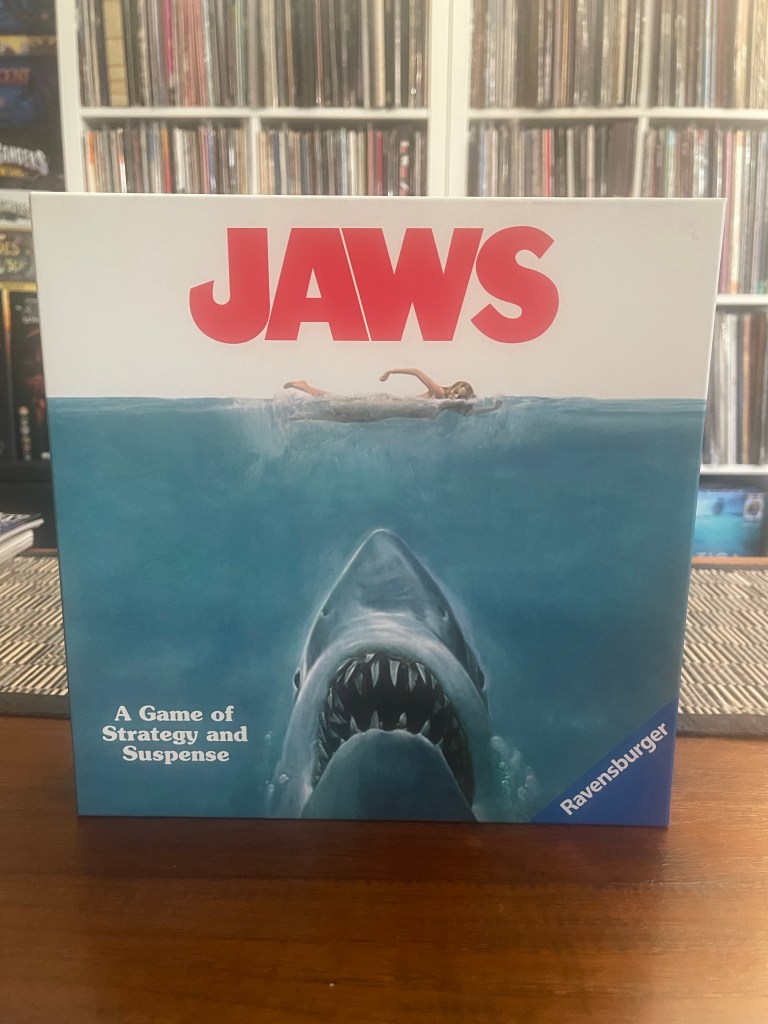
Horror movies are a great source of inspiration for games. The bigger the horror movie, the more potential for success the game has, and when you take something like Steven Spielberg’s Jaws and make it into a game, provided it’s a fun game, you can pretty much well guarantee you are onto a winner.
Jaws is the blockbuster film from the 70s, based on a book by Peter Benchley, that launched Spielberg’s career and has had several video games based upon it, such as Jaws Unleashed on the Playstation 2 and PC and Jaws: Ultimate Predator on the Nintendo 3DS, not to mention a Super Nintendo game called simply Jaws, that came out in 1987, but more recently several board game companies have swam up to the licence and eaten it with much ferocity. We have had the inevitable Jaws Monopoly, the Funkoverse Strategy Game: Jaws (which comes with two smaller sized Funko Pops to appease the worldwide cult of Pop fans), and this game, from Ravensburger, titled simply Jaws.
Ravensburger make some amazingly thematic board game (if you haven’t tried Villainous, give it a go. It is Disney themed but lots of fun), and Jaws is one of those games that follows the basic plot of the film. This game is a three versus one game, with three players playing Quint, Brody and Hooper as they attempt to destroy the fourth player, who plays the big shark. This game is right in fashion of the current video game trend of have one vs many games like Dead by Daylight (also coming soon as a board game) and Evil Dead the Game.
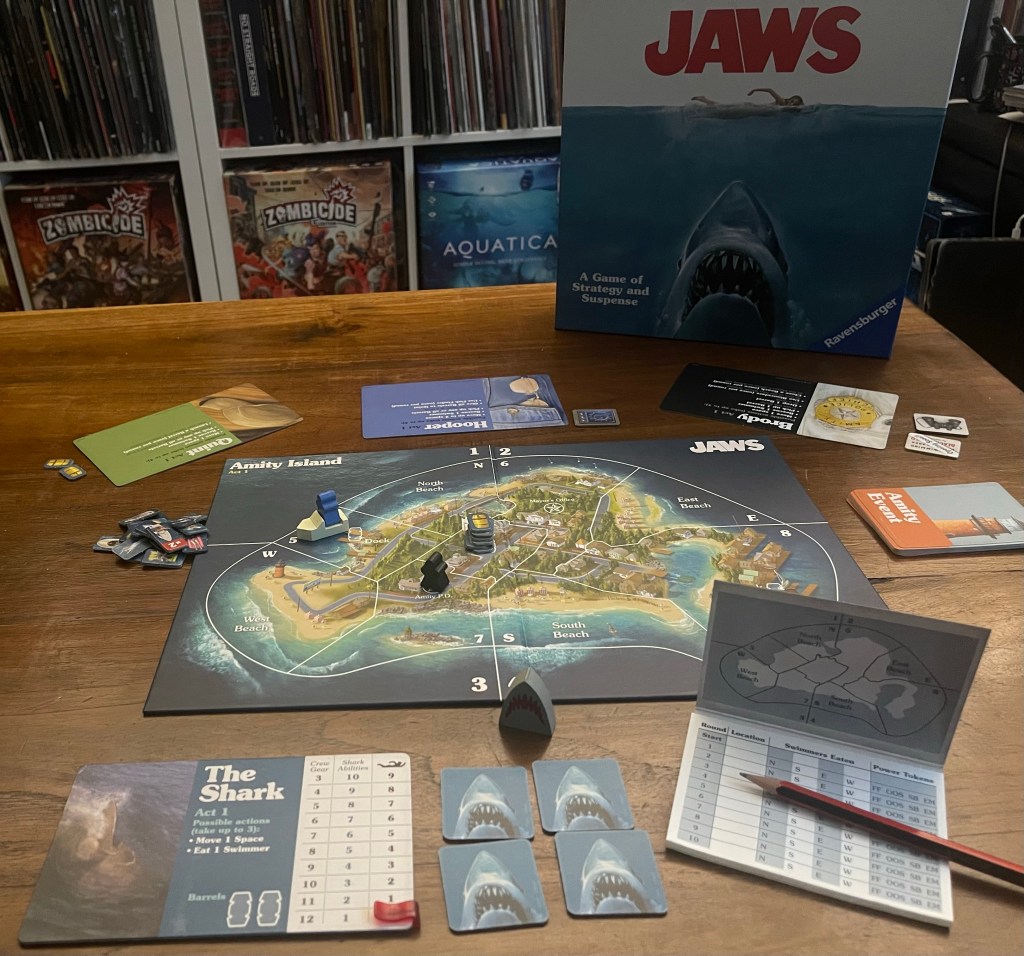
This gameplay is divided into two halves. This first half of the game, on one side of the board, has a map of Amity Island and sees the human players attempting to stop Jaws from eating swimmers and at the same time attempt to locate the shark with location barrels. Each player has a series of things they can do in their turn which is thematic to the character, as is their extra special abilities, like Hooper’s fish finder for example.
Act 1 – from the shark players POV
Quint and Hooper spend their time searching for the shark by placing location barrels in the water, which the shark attempts to avoid, whilst Brody shuts beaches and delivers more barrels to the docks for them to use… Brody’s piece doesn’t go in the water because you know, Brody doesn’t like the water.
You might be asking yourself,’ but how does the shark avoid being located? Doesn’t the player have a piece on the boards?’ The answer to that is no, the shark player uses a separate notebook to record where on the map, signified by map locations, and doesn’t place their piece on the board until they have been spotted. They move around eating swimmers secretly, only revealing where they are if they go through a space with a barrel, or if they are spotted from the beach by Brody, or when they chow down on a beach goer.
Each turn, an Amity Event phase card is revealed which shows a special ability one of the players may have in that turn, but also deposits more swimmers in the water!
This first part of the game is finished when one of two things happen: either the shark ends up with two barrels attached and their position fully revealed, or they eat nine swimmers. How the Act Two of the game plays out is decided by how successful either team have been. If the shark eats more swimmers, it gets a higher amount of special ability cards in the second act, but if the humans stop them early enough, they get extra gear to stop the shark.
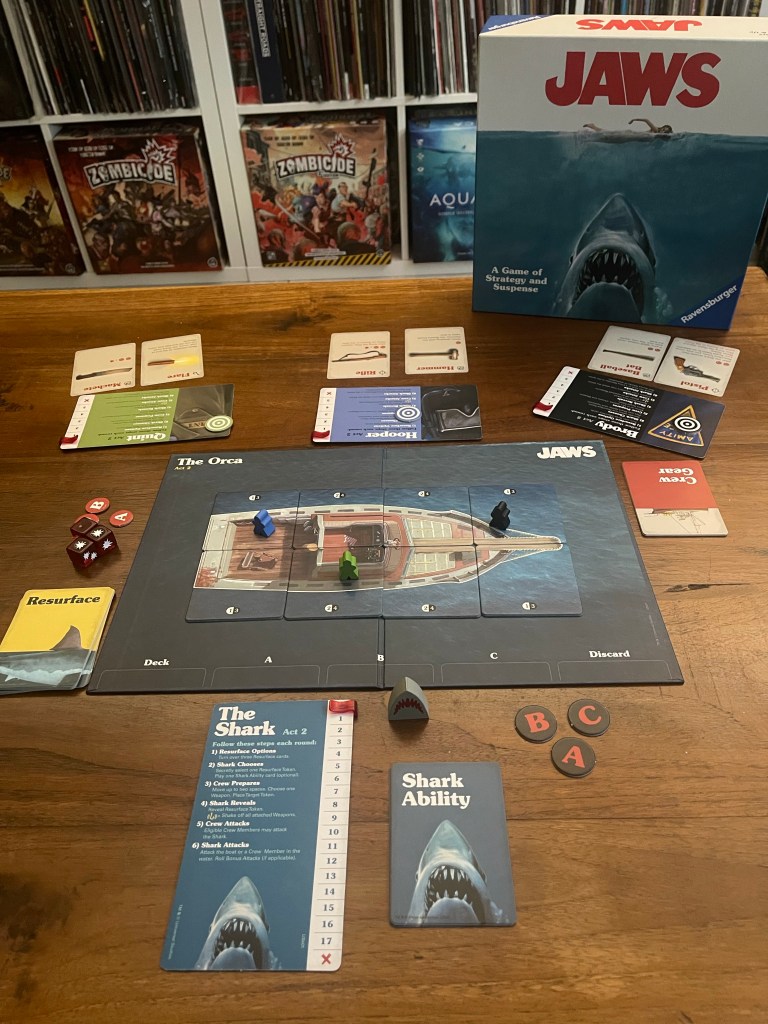
For the second act sees the board turn over to reveal a sunken version of the shop The Orca, where undamaged images of the ship overlays are placed on top. Cards are issues to either team regarding their success in the previous act. For example, if the shark ate five swimmers before having two barrels attached, they would receive six shark ability cards, and the crew would get seven pieces of crew gear.
Act 2 – from the shark players POV
Each turn the shark attacks the boat and the crew prepare themselves for the attack. The shark player reveals each turn where they MIGHT attack, giving the crew an opportunity to be ready to defend, and play continues as the shark either slowly sinks the boat, attacking the crew and having them lose their life points, or the crew are able to kill the shark with lucky dice rolls in combination with their gear.
Obviously there is a lot more to this than my summary here, and I suggest you take a look at Becca Scott’s How to play Jaws YouTube Video ( How to Play Jaws – YouTube ) before purchase if you want a better idea of how to play.
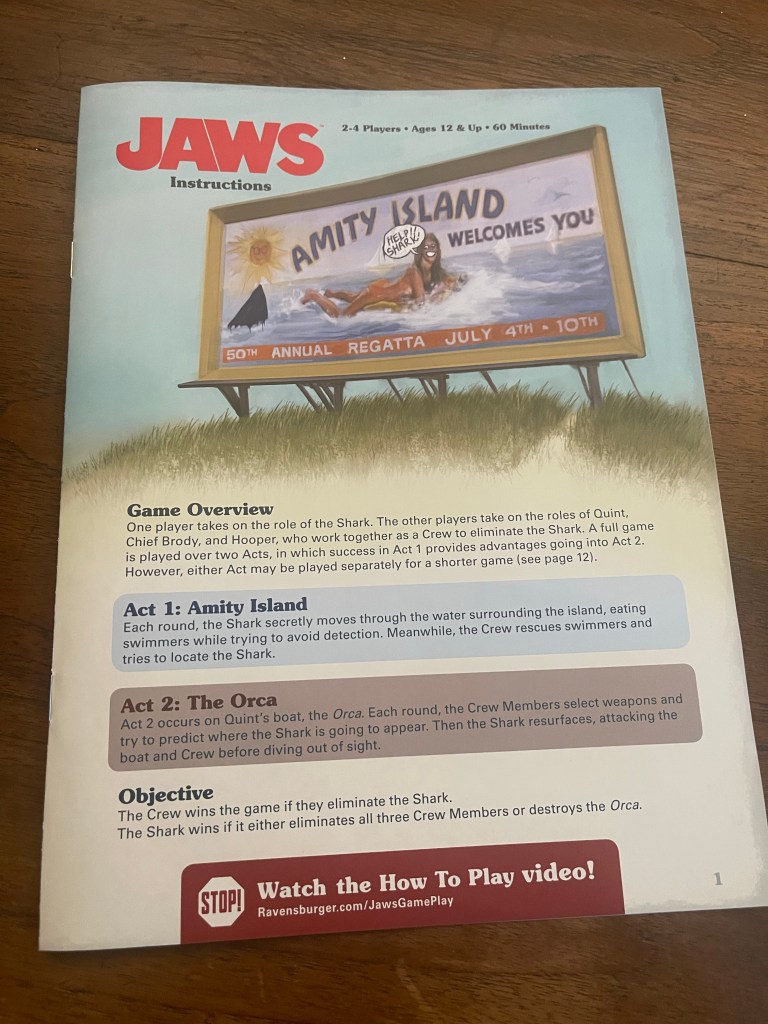
The Jaws board game instruction manual
Thematically, this game is amazing. The pieces all represent their characters well, and the dividing of the two acts is a clever way to play the game. The instructions are clear and concise and well-illustrated, with some great examples of play.
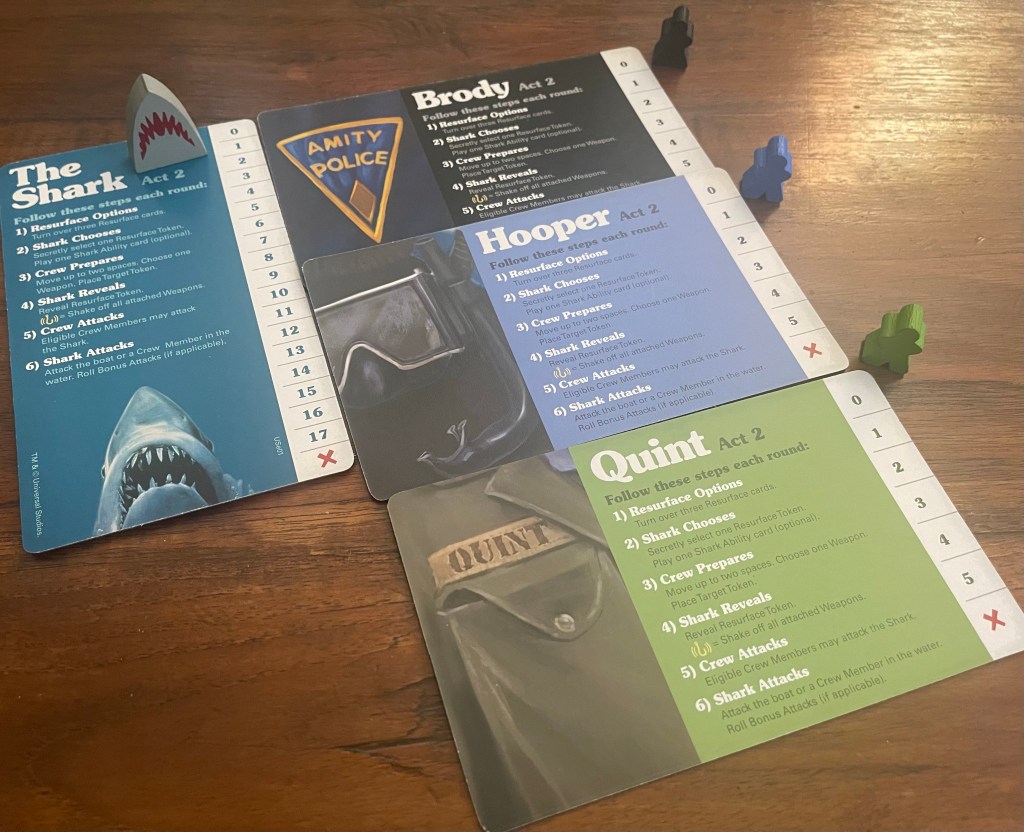
The player cards from Jaws
The game is lots of fun and that to be expected from designers Prospero Hall, who gave us the previously mentioned Villainous, as well as other thematically on-point games like Horrified, Fast and Furious: Highway Heist and Godzilla: Tokyo Clash.
I do have to say I have one problem with it and that is the player count. This is a three vs one game, and whilst I appreciated that the instructions say that it can be played with one player playing all the crew, or two players sharing one crew member, but it is much less fun. When three players are the crew there is a lot of discussion as to what to do next, where with one player, they sit studiously in silence for several minutes while they decide what each crew member will do. As the shark player, knowing where you are in act one and watching as three people talk about how they are NO WHERE near you is a great deal of joy, and that’s what games are all about, right? Fun and interaction!
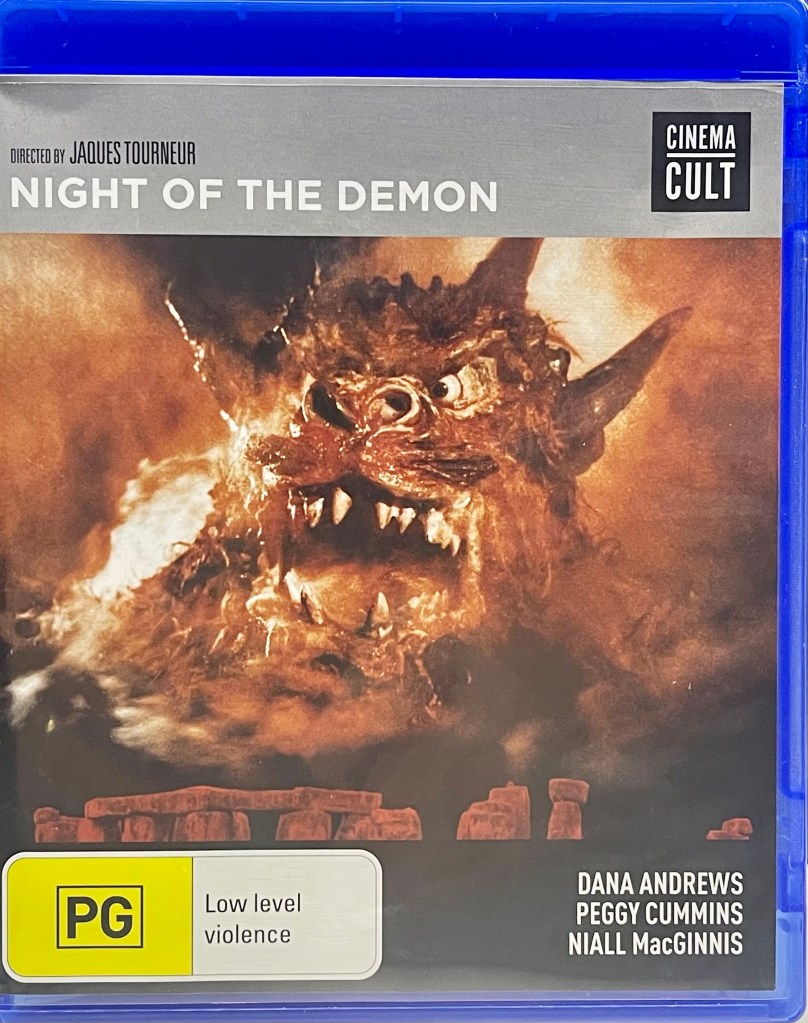
The cover to the Australia Cinema Cult release of Night of the Demon
Film: To say that the ghost stories of Montague R. James are well respected is possibly an understatement. The very fact that a type of horror story is referred to as Jamesian should underline that fact. The Jamesian story type is a path well trod not just by writers, but by filmmakers as well. The Jamesian method has three main features: the story takes place in a small, generally English, community or perhaps a University or other place of learning, it has a sceptical scholar as it’s protagonist and some sort of cursed tome that effects either ghosts of demons.
It’s appropriate for a film to use the Jamesian method too. To have a protagonist in the film who has to have a lot of the environments or traditions of a location or society explained to them makes for an easy way for the viewer to comprehend as well, and it also works for the big reveal if the society has a hidden secret. This method also works well in science fiction to explain more high concept stuff, like in The Last Starfighter or even Star Wars, as Luke need the ways of the grater world explained to him.
This movie, Night of the Demon, is based on one of James’ works, ‘Casting the Runes’, and was adored by Charles Bennett, who also wrote The Lost World and Voyage to the Bottom of the Sea, and was directed by Jacques Tourneur, who directed The Comedy of Errors and I Walked With a Zombie. It had a difficult release as the producer Hal E. Chester wanted a visual representation of the demon onscreen, where as Tourneur and Bennett wanted to avoid that. The film had two releases, one which was cut by a full 10 minutes and titles “Curse of the Demon’, but here was have the full, 95 minute version on Bluray from Cinema Cult.
Karswell (Niall MacGinnis) and Holden (Dana Andrews) regard each other
After Professor Henry Harrington (Maurice Denham) died mysteriously during investigating the occult doings of a certain Dr. Karswell (Niall MacGinnis), psychologist John Holden (Dana Andrew’s) travels to England to continue the investigation.
Karswell obviously objects to Holden’s interference, and slips a curse onto his person, one which will cause him to be visited by a demon and murdered at a particular time and date.
Of course, Holden thinks this is a pile of hoo-ha, and even at the insistence of Harrjngton’s niece, Joanna (Peggy Cummins) who is investigating her uncles death, he still remains an unbeliever… even as the evidence for the curse gets more and more apparent! Will he survive the curse? Does it even exist?
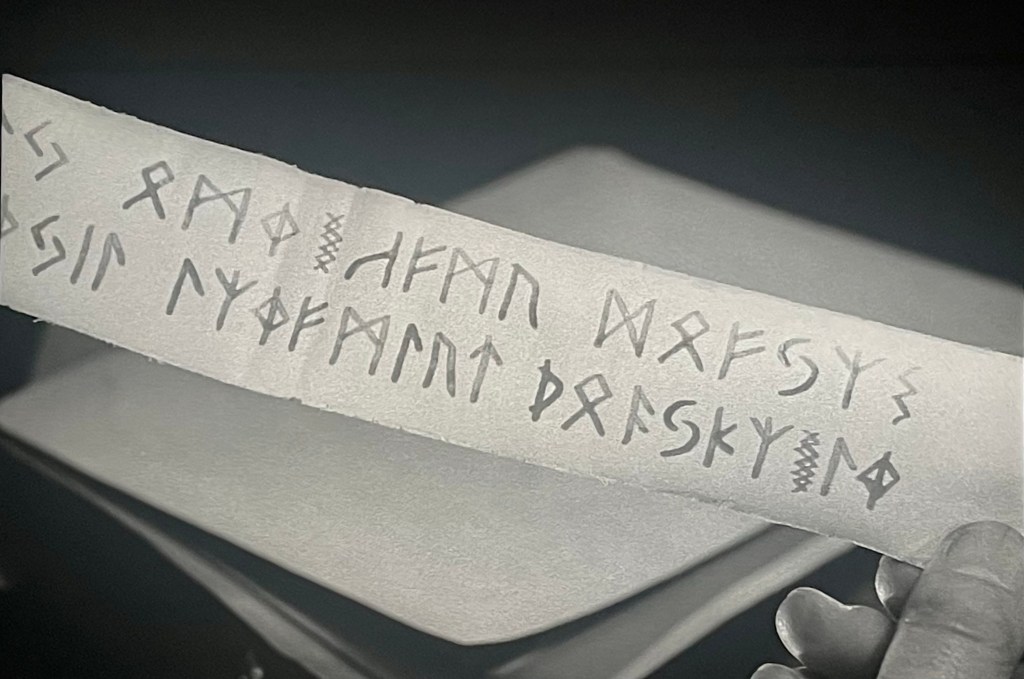
The curse!!
Obviously a film of this generation has several elements that a modern film fan may not like. The acting is very ‘on stage’ and ‘performancey’ (you know what I mean, it’s very vaudevillian), the effects are very low-key, but for their time they look fantastic, well, until you get to the silly looking demon, but the silliness of his look adds to the charm of the whole thing.
The story, with its aforementioned ‘Jamesian’ influences, is great. The slow reveals are paced so well, and every introduction of a new character adds to the fun. Even better, the bad guy is announced from the very start so there is no deception, and his intentions are always clear, but how will he get away with his shenanigans, and how far he’ll go are where the expanding story sits.
Trigger warning: there is an Indian character who may not sit well with some as the part is played by Caucasian actor, Peter Elliot. It’s not a dealbreaker, but some may find it offensive.
This is a great film, and a worthy addition to any horror fans collection. Best thing about this edition is that the Cinema Cult edition cover has ‘85 minutes runtime’ on it, meaning it’s the cut ‘Curse of the Demon’ version, but it actually is the uncut ‘Night…’ version.
Score: ****
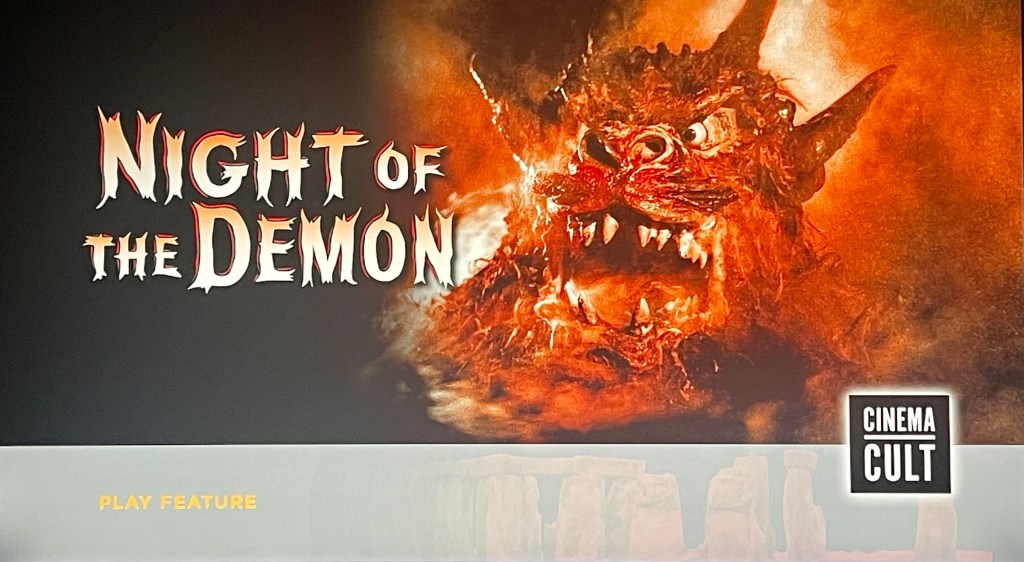
The menu screen from the Night of the Demon Bluray
Extras: Not a sausage.
Score: 0
WISIA: It a great film, so definitely.
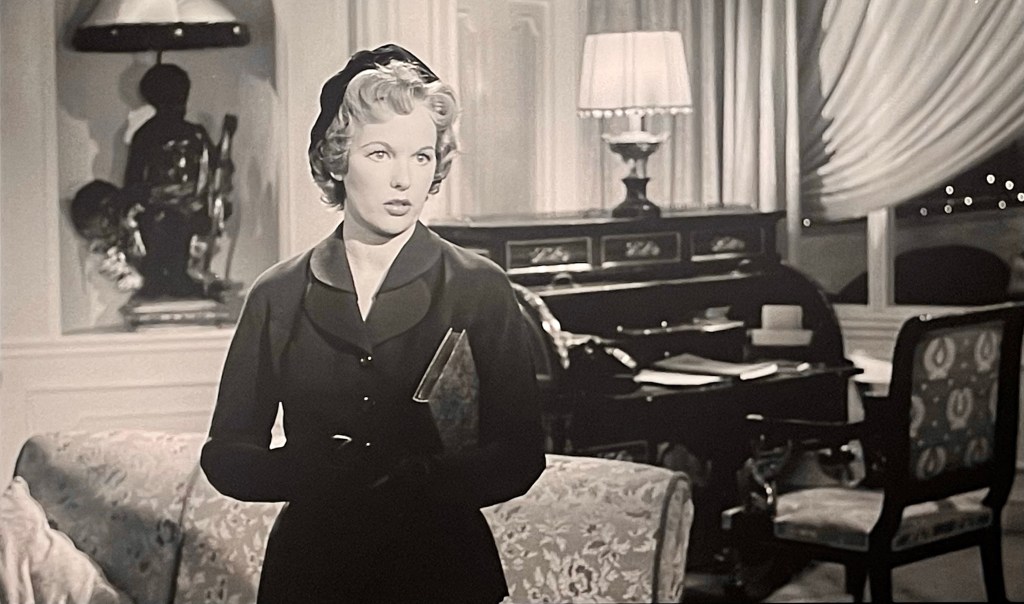
Joanna (Peggy Cummins) looks concerned, and fair enough.
This review was done with the Australian Cinema Cult Bluray release of the film










 Digital Retribution